- Analytics
- Market Overview
World stock markets drop due to increased global political risks - 8.8.2014
World stock markets dropped altogether on Thursday, due to increased global political risks. Russia published a list of food products from the countries which previously imposed sanctions on Russia (the United States, the European Union, Australia, Canada and others). The list is quite extensive. It is assumed that the countries facing the response Russian sanctions can lose up to $15 billion per year.
Note that for this reason Russian ADRs started to rise in price unexpectedly. The US President Obama approved airstrikes on Iraq, which can have a negative impact on global markets. The release of American macroeconomic data appeared to be positive yesterday. Initial Claims value fell to 289,000 people, much less than expected. The average number of unemployed for four weeks dropped to its low since February 2006. The American economy indicates the monthly growth of more than 200,000 workplaces for the sixth month in a row. This positive trend is observed for the first time since 1997. Volume of trading on the US exchanges declined to $5.5 billion stocks on Thursday, which is 21% lower than the 5-day average. Prior Productivity index for the second quarter is to be released today at 12.30 CET. Volume changes in wholesale inventories for June will be announced at 14-00 CET. The forecast appears to be slightly positive. Note that there will be no significant US macroeconomic data on Monday. The profit for the second quarter of the companies listed in S&P 500 (75%) outperformed the preliminary forecasts.
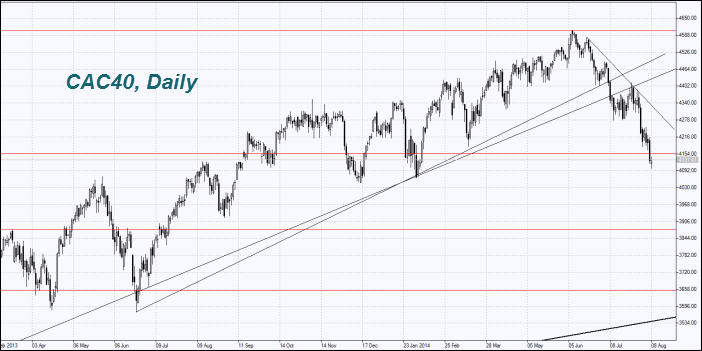
European stock indices continue to fall today. As we have already mentioned, the EU can be affected more by the Ukraine political instability and the reciprocal economic sanctions against Russia. For example, Nokian Renkaat Oyj stocks tumbled nearly 8%, due to the reduced Russian sales by a third in the first half of the year. Russia warned of a possible ban on European aircraft flights over its territory. For this reason, the stocks of airlines became considerably cheaper. The ECB meeting decided to keep rates at current levels yesterday. Mario Draghi, the President of the ECB, declared the need of loose monetary policy continuation to stimulate the economy, including due to the further weakening of the euro. The ECB is considering to launch the "quantitative easing" program (money issue) according to the Fed example. Due to all these factors, FTSEurofirst 300 index tumbled today to the 4,5-month low. Good data on German foreign trade which supported the euro growth has come out in the morning. Further macroeconomic information from the EU will appear only on Tuesday.
Nikkei slipped 3% today, which was the 5-month low. Investors are concerned about Russian sanctions and a fall in exports. An additional negative factor was the strengthening of the yen. It is considered as a "defensive" currency amid the Ukraine political crisis in Europe. Japanese macroeconomic data was positive. In June, the trade deficit narrowed to -537.1 billion yen. It was more than expected. The Bank of Japan kept its monetary policy parameters unchanged. It implies a currency issue in the amount of 60 to 70 trillion yen per year. Now 306 companies listed the Tokyo Stock Exchange submitted their reports, of which 59% exceeded the profit forecasts. Macroeconomic data in Japan will be released on Monday early in the morning: consumer confidence index at 5-00 CET, and at 6-00 CET – Machine tool orders in July.
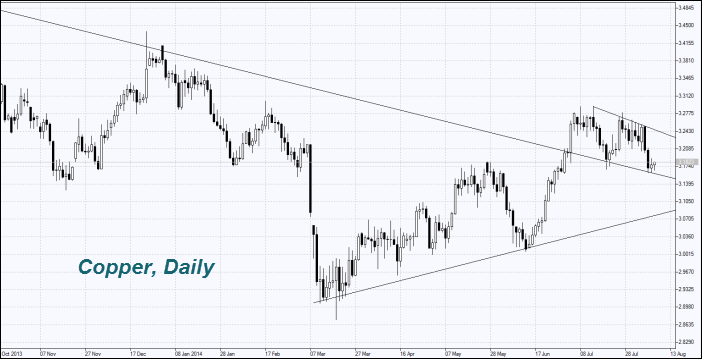
Quite positive macroeconomic data on Chinese foreign trade in July has been released this morning. The budget surplus in July increased to $47.3 billion. Due to this, Chinese stocks rise against the world market. However, a significant increase in commodity futures prices is not observed. Since the surplus growth was caused by the Chinese imports reduction by 1.6% to its lowest level since April 2013, and the exports growth by 14.5%. In particular, copper inventories slipped 2.9% compared with June. We believe that it suspends considerably the copper world prices growth despite its reduction on the London Metal Exchange for 13 consecutive days to the lowest level since July 2008.
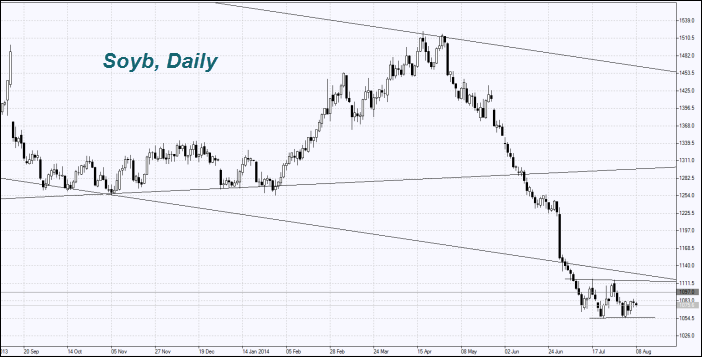
Soybean imports to China in July jumped 17%, due to low world prices. It is difficult to say whether soybean purchasing continues or not. Imported soybean inventories reached its high since last September and amounted to 6.3 million tons, according to China National Grains and Oils Information Center. However, there was no information about the plans for the further implementation of the Chinese state reserves of soybean, which brought down the previous world market prices. Note the rising cost of oil and gold amid the geopolitical instability in Europe and the Middle East.
News

xAI Leeching off SpaceX
SpaceX reported its Q3 results on October 20, and the numbers were strong. Revenue was $14.58 billion, up 161% from a year...

Why Alphabet lost $500 billion in a Day
On October 29, Alphabet's stock price fell by 13%, and whipped out $500 billion in market capitalization. Let’s understand...
If Fed Raise Rates Again, What Will Happen to Your Cash
When central banks adjust interest rates, cash accounts are the first to react. Money market funds hold short-term debt,...

Anthropic Needs Stock Market to Pay Its Bills?
Anthropic is getting ready to go public - valuation 2 trillion dollars. Official story: revenue is booming, growth is growing,...

Optimism! Sponsored by the creators of AI
Stock market is now in a wave of forced optimism, sponsored by the creators of artificial intelligence. Huge investments...

Fight Behind Nvidia $20bn Groq Deal
Nvidia's $20 billion deal with Groq was presented as a licensing agreement, but two former Groq engineers dispute that description...
Explore our
Trading Conditions
- Spreads from 0.0 pip
- 30,000+ Trading Instruments
- Stop Out Level - Only 10%
Ready to Trade?
Open AccountSee Also