
- Education
- Forex Technical Analysis
- Basic Concepts
- Forex Channel
Forex Channel
Forex Channel is one of key notions of technical analysis. It is defined as a sustainable corridor of price fluctuations with a roughly constant width.
What Are Trading Channels
Trading channels are a technical analysis tool used in financial markets to identify and visualise the boundaries within which an asset's price consistently moves over a given period. A channel is formed by drawing two parallel trendlines on a price chart — one connecting a series of swing highs and one connecting a series of swing lows — creating a corridor that contains price action. The upper line acts as dynamic resistance, while the lower line acts as dynamic support.
Traders use channels to determine the prevailing trend direction, anticipate where price is likely to reverse or accelerate, and identify high-probability entry and exit points without relying solely on lagging indicators.
Types of Trading Channels
Trading channels are classified by the direction of their slope:
- Ascending channel — price moves upward between two rising parallel trendlines, indicating a bullish trend with consistent higher highs and higher lows.
- Descending channel — price moves downward between two falling parallel trendlines, indicating a bearish trend with consistent lower highs and lower lows.
- Horizontal channel — also called a ranging or sideways channel, price oscillates between a flat resistance level and a flat support level with no clear directional bias.
Forex Channel Formation
Visually the channel is described by two parallel trendlines, a support below connecting important lows and a resistance above connecting important highs.
- In an uptrend the trendlines have positive slope.
- In a downward trend the trendlines have negative slope.
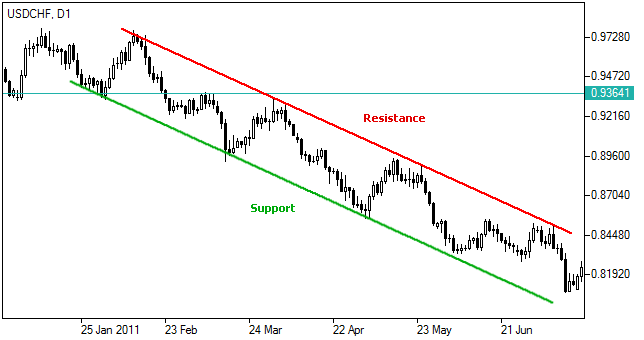
Interpretation of Forex Channel
- Positively sloping channel suggests that forces of demand are permanently greater than forces of supply. However a break below the lower trendline (plus certain deviation is widely common) may be a sign of the channel’s break and be considered a sell signal.
- Negatively sloping channel suggests that supply is permanently overwhelming demand. However a break above the upper trendline (plus certain deviation is widely common) may be a sign of the channel’s break and be considered a buy signal.
- Until the channel is broken the trendlines are believed to keep prices inside the channel acting as support and resistance lines.
How to Trade Channels in Forex
Trading forex channels is a structured, rule-based approach to capturing price movement within well-defined boundaries. The method works across all major currency pairs and timeframes, making it one of the most versatile techniques available to technical traders. Below is a step-by-step framework for applying it effectively.
1. Identify the prevailing trend
Before drawing any channel, establish the market's directional bias on your chosen timeframe. Look for a clear sequence of higher highs and higher lows to confirm an uptrend, or lower highs and lower lows for a downtrend. A sideways or ranging market, where price oscillates between a horizontal ceiling and floor, forms the basis of a horizontal channel. Identifying trend direction first prevents you from drawing channels on random price noise rather than meaningful structure.
2. Draw the channel correctly
Once the trend is confirmed, plot the primary trendline along a minimum of two swing lows in an ascending channel, or two swing highs in a descending one. Then draw a parallel channel line on the opposite side of price — connecting at least two swing highs in an ascending channel, or two swing lows in a descending one. The two lines must remain strictly parallel. Avoid forcing the lines to touch every candlestick wick; the goal is to capture the dominant price corridor, not to eliminate every deviation. A third touch on either boundary significantly increases the channel's reliability.
3. Define your two trading approaches
Channel traders operate within one of two strategies, and choosing between them before a trade is placed is essential.
- Range trading within the channel. When price reaches the lower boundary (support), it presents a potential long entry. When price reaches the upper boundary (resistance), it presents a potential short entry. This approach works best in well-established channels with multiple boundary touches and in markets with no strong fundamental catalyst in play.
- Breakout trading. When price closes convincingly beyond either boundary — particularly after a prolonged channel — it signals a potential trend acceleration or reversal. Traders wait for the breakout candle to close outside the channel, then enter in the direction of the break. A retest of the broken boundary, which now acts as new support or resistance, offers a higher-probability entry with a tighter stop.
4. Set entries, stops, and targets
For range trades, place your entry order just inside the channel boundary and position your stop-loss a defined number of pips beyond the line — accounting for normal volatility rather than sitting directly on the trendline. A common profit target is the opposite channel boundary, giving a clear risk-to-reward ratio before the trade is opened.
For breakout trades, the initial target is typically the projected channel width measured from the breakout point. If the channel is 80 pips wide from boundary to boundary, the minimum measured target after a breakout is 80 pips in the breakout direction. Adjust targets based on nearby support and resistance levels, previous swing highs or lows, or round-number price levels that may act as obstacles.
5. Add confirmation before entry
Price touching a channel boundary alone is not a trade signal — it is an alert. Before committing capital, look for one or more of the following confirmations:
- A reversal candlestick pattern at the boundary, such as a pin bar, engulfing candle, or inside bar.
- RSI divergence, where price makes a new high or low within the channel but momentum does not confirm it.
- MACD histogram showing declining momentum as price approaches the boundary.
- Reduced volume on the move into the boundary, followed by expanding volume as price reverses.
Any single confirmation strengthens the trade. Two or more in agreement make the setup materially more reliable.
6. Manage the trade as price develops
Once in a range trade, monitor price as it moves toward your target. If price stalls midway through the channel — particularly at a previous consolidation zone or a significant round number — consider taking partial profit and moving the stop to breakeven. Full targets are not always reached, and protecting a portion of gains is prudent risk management.
For breakout trades, trail your stop-loss beneath successive swing lows (in a bullish breakout) or above successive swing highs (in a bearish one) to lock in gains as the new trend develops.
7. Invalidate the channel when the structure breaks down
No channel lasts indefinitely. A channel is invalidated when price closes decisively beyond a boundary without returning within two to three candles. At that point, stop attempting to trade the range and reassess: either manage an open breakout trade, or wait for a new channel to form on a clean price structure. Re-drawing a channel every time price is slightly breached leads to overtrading and loss of objectivity.

Not sure about your Forex skills level?
Take a Test and We Will Help You With The Rest
You can see the graphical object on the price chart by downloading one of the trading terminals offered by IFC Markets.